SWA User Guide for Solavixa Web Archive Studio
Web URL · Local HTML · ChatGPT ZIP · PDF · DOCX · HTML · Markdown · OCR · Manifest · Assets · Licensing
SWA user guide for Solavixa Web Archive Studio helps you understand web archiving, ChatGPT export ZIP import, local HTML input, output formats, OCR, archive folders, licensing, and common troubleshooting steps.
SWA User Guide for Web Archiving and AI Conversation Export
This SWA user guide is designed for users who want to preserve web pages, local HTML files, and official ChatGPT export ZIP archives as structured offline documentation.
Solavixa Web Archive Studio creates archive packages with customer-ready outputs such as PDF, DOCX, HTML, Markdown, OCR text, manifest files, images, files, and organized asset folders.
Main Window Overview
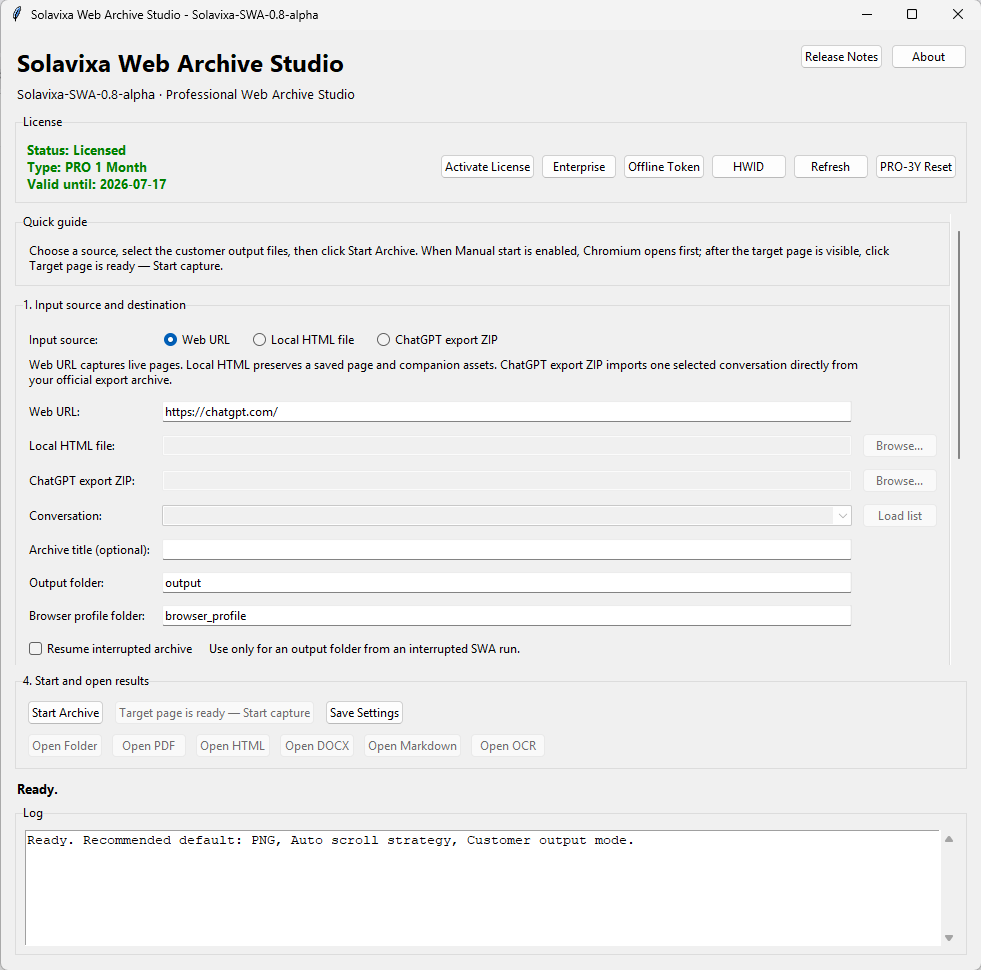
The main SWA window is divided into four practical areas: application information and licensing, input source and destination settings, capture options, output file settings, and final start/open-result controls.
The interface is designed as a guided workflow. First choose what you want to archive, then choose where the archive should be saved, select the desired output formats, and start the archive process.
Header Buttons
Release Notes
Click Release Notes to open the current SWA release notes file. This helps users see what changed in the current version, which features were added, and what fixes were included.
About
Click About to open product information about Solavixa Web Archive Studio, including version and release summary details.
License Section
The License section displays the current license status and provides access to activation and support-related actions.
License status
The license status area shows whether SWA is running in Trial, PRO, Enterprise, expired, blocked, or licensed mode. It may also show the license type and validity date where available.
Activate License
Use Activate License to activate a standard PRO license key. This is used for PRO 1 Month and PRO 3 Years licenses.
Enterprise
Use Enterprise for online Enterprise activation. This is intended for Enterprise customers who activate SWA through the Enterprise workflow.
Offline Token
Use Activate License to activate a standard PRO license key. This is used for PRO 1 Month and PRO 3 Years licenses.
HWID
Click HWID to display the hardware ID used for license binding and support-related activation checks.
Refresh
Click Refresh to reload the current license status and update the displayed license information.
PRO-3Y Reset
Use PRO-3Y Reset when a PRO 3 Years license needs to be reset for another device according to the license reset rules. The reset process may require the order email and WooCommerce order ID.
Quick Guide
The Quick guide area explains the recommended basic workflow:
Choose a source, select customer output files, then click Start Archive. When Manual start is enabled, Chromium opens first. After the target page is visible and ready, click Target page is ready — Start capture.
Input Source and Destination
This section controls what SWA will archive and where the result will be saved..
Input source
SWA supports three main input sources:
- Web URL
- Local HTML file
- ChatGPT export ZIP
Choose the input source that matches your archive task.
Web URL
Use Web URL when you want SWA to capture a live web page. Enter the page address into the Web URL field.
This mode is useful for long web pages, online documentation, public content, research pages, support pages, and other web content that can be accessed in the browser workflow.
Local HTML file
Use Local HTML file when you already have an HTML file saved on your computer. Click Browse to select the file.
This mode is useful when you want to archive or re-export locally stored HTML content and preserve the page with available supporting assets.
ChatGPT export ZIP
Use ChatGPT export ZIP when you want to import an official ChatGPT export archive. Click Browse to select the ZIP file, then click Load list to load available conversations.
After the list is loaded, choose one conversation from the Conversation dropdown and start the archive process.
For ChatGPT ZIP input, SWA creates document-based outputs from the selected conversation rather than capturing a live web page screenshot.
Conversation
The Conversation dropdown is used with ChatGPT export ZIP input. It lets you select which conversation from the export ZIP should be archived.
Load list
Click Load list after selecting a ChatGPT export ZIP file. SWA reads the available conversation list and prepares it for selection.
Archive title optional
Use Archive title optional when you want to set a custom title for the archive. If left empty, SWA uses the detected or generated title from the source content.
Output folder
Output folder defines where the archive will be created. SWA stores generated files, folders, and asset outputs inside the selected output location.
Browser profile folder
Browser profile folder is used by the browser-based capture workflow. It can help preserve a separate browser profile for archiving sessions.
Resume interrupted archive
Enable Resume interrupted archive only when you want to continue an archive from an output folder created by an interrupted SWA run.
Resume folder
Resume folder points to the previous interrupted SWA output folder. Use Browse to select the folder before starting the resume workflow.
Capture Options
Capture options control how SWA captures visual web content and how the browser-based workflow behaves.
Image format
Image format controls the screenshot image format used during capture. The available options are PNG and JPEG.
PNG is useful for clean visual quality. JPEG can reduce file size, depending on selected quality and source content.
Crop mode
Crop mode controls how SWA handles captured page areas.
- Content is intended for the main content area.
- Scroll is intended for scrolling capture behavior.
- Full is intended for fuller page capture behavior where appropriate.
The best option depends on the source page structure.
Max pages
Max pages limits how many captured pages or segments SWA may create during a long archive run. This helps prevent accidental very large captures.
Overlap px
Overlap px controls overlap between captured segments. A small overlap can help reduce visible gaps between captured parts in long-page workflows.
JPEG quality
JPEG quality controls the compression quality when JPEG image format is selected. Higher values improve quality but can increase file size.
Scroll strategy
Scroll strategy controls how SWA moves through long or dynamic pages.
Available options include:
- auto
- chat_container
- normal_webpage
- infinite_lazy_page
- full_document
- manual_fallback
auto
Use auto for the recommended default behavior. SWA attempts to detect the best practical capture method.
chat_container
Use chat_container for ChatGPT-like interfaces and pages where the main content is inside a scrollable conversation container.
normal_webpage
Use normal_webpage for standard web pages that scroll normally from top to bottom.
infinite_lazy_page
Use infinite_lazy_page for feeds or pages where new content loads while scrolling.
full_document
Use full_document when a single full-document capture is more suitable than segmented scrolling.
manual_fallback
Use manual_fallback when automatic scrolling is not reliable and you need SWA to capture from a manually prepared position
Cover page
Enable Cover page when you want SWA to include a cover page in supported output formats.
Show browser
Enable Show browser when you want to see the browser window during capture. This is useful for login steps, checking the target page, or confirming that the correct content is visible.
Manual start
Enable Manual start when you want SWA to open the target page first and wait for your confirmation before capture begins.
This is useful when you need to log in, close popups, accept page prompts, scroll to a specific place, or verify that the target content is ready.
Hide floating UI
Enable Hide floating UI when you want SWA to attempt to hide floating interface elements before capture. This can help reduce unwanted overlays in the final archive.
Output Files
The Output files section controls which customer files SWA should create
PDF visual archive
Enable PDF visual archive to create Archive.pdf.
For Web URL and Local HTML workflows, PDF is intended as a visual archive. For ChatGPT ZIP input, SWA creates a document-based PDF from the selected conversation.
DOCX editable document
Enable DOCX editable document to create Archive.docx.
DOCX output is useful when users want an editable document that can be reviewed, shared, modified, or stored as project documentation.
HTML offline archive
Enable HTML offline archive to create Archive.html and related offline archive files.
HTML output is useful for reviewing archived content in a browser-readable format.
Markdown text archive
Enable Markdown text archive to create Archive.md.
Markdown is useful for plain-text documentation, knowledge bases, research notes, and workflows where the archived content may be reused in writing or documentation systems.
OCR text from images
Enable OCR text from images to create Archive_OCR.txt when image OCR is available and images are present.
OCR can extract readable text from images, but accuracy depends on image quality, resolution, contrast, language, and layout complexity.
Output mode
Output mode controls how clean or technical the output folder should be.
Customer mode
Customer mode creates a cleaner output folder intended for normal review, sharing, and customer-ready archives.
Advanced mode
Advanced mode keeps additional technical diagnostics and internal files for troubleshooting. Use this mode when testing, debugging, or investigating capture behavior.
Start and Open Results
The Start and open results section stays visible at the bottom of the SWA window.
Start Archive
Click Start Archive to begin the archive process. SWA checks the selected input source, output settings, license or trial state, and then starts the correct workflow.
Target page is ready — Start capture
This button is used when Manual start is enabled. After Chromium opens and the target page is visible, click Target page is ready — Start capture to allow SWA to begin capturing.
Save Settings
Click Save Settings to store the current SWA settings for future sessions.
Open Folder
Click Open Folder to open the output folder after the archive is complete.
Open PDF
Click Open PDF to open Archive.pdf after it has been created.
Open HTML
Click Open HTML to open the generated HTML archive.
Open DOCX
Click Open DOCX to open Archive.docx after it has been created.
Open Markdown
Click Open Markdown to open Archive.md after it has been created..
Open OCR
Click Open OCR to open Archive_OCR.txt after OCR output has been created.
Status
The status line shows the current application state, such as Ready, preparing archive capture, importing ChatGPT export ZIP, or archive complete.
Log
The Log area shows detailed progress messages during the archive process. It helps users understand what SWA is doing and can be useful for troubleshooting.
How to Archive a Web Page Step by Step
Step 1 — Choose Web URL
Select Web URL as the input source.
Step 2 — Enter the target URL
Paste the web page address into the Web URL field.
Step 3 — Choose the output folder
Select the output folder where SWA should create the archive.
Step 4 — Keep recommended capture settings
For most users, the recommended starting setup is PNG, auto scroll strategy, Manual start enabled, and Customer output mode.
Step 5 — Choose output files
Select the outputs you need, such as PDF, DOCX, HTML, Markdown, and OCR.
Step 6 — Start the archive
Click Start Archive. If Manual start is enabled, Chromium opens first.
Step 7 — Prepare the target page
If needed, log in, close popups, accept prompts, or wait until the content is fully loaded.
Step 8 — Confirm capture
Click Target page is ready — Start capture.
Step 9 — Review the result
After completion, use Open Folder, Open PDF, Open HTML, Open DOCX, Open Markdown, or Open OCR to review the generated archive files.
How to Archive a Local HTML File
Step 1 — Choose Local HTML file
Select Local HTML file as the input source.
Step 2 — Browse for the file
Click Browse and choose the local HTML file.
Step 3 — Select the output folder
Choose where SWA should create the output archive.
Step 4 — Choose output files
Select PDF, DOCX, HTML, Markdown, OCR, or any combination supported by your workflow.
Step 5 — Start Archive
Click Start Archive and wait for SWA to process the local HTML content.
Step 6 — Review the output
Open the created files and confirm that the content, images, and available assets were preserved correctly.
How to Import a ChatGPT Export ZIP
Step 1 — Export your data from ChatGPT
Create an official ChatGPT export ZIP using the export feature in your ChatGPT account.
Step 2 — Choose ChatGPT export ZIP in SWA
Open SWA and select ChatGPT export ZIP as the input source.
Step 3 — Select the ZIP file
Click Browse and select the exported ZIP archive.
Step 4 — Load the conversation list
Click Load list. SWA reads the available conversations from the ZIP file.
Step 5 — Choose a conversation
Select the conversation you want to archive from the Conversation dropdown.
Step 6 — Choose outputs
Select PDF, DOCX, HTML, Markdown, OCR, or the formats you need.
Step 7 — Start Archive
Click Start Archive. SWA imports the selected conversation and creates structured output files.
Step 8 — Review the archive
Open the generated output folder and review Archive.pdf, Archive.docx, Archive.html, Archive.md, Archive_OCR.txt if enabled, manifest.json, and asset folders.
Output Folder Contents
A typical SWA archive may include:
- Archive.pdf
- Archive.docx
- Archive.html
- Archive.md
- Archive_OCR.txt
- Archive_Analysis.txt
- Archive_Analysis.json
- manifest.json
- assets/images
- assets/files
The exact files depend on selected output options, input source, OCR availability, and source content.
Trial, PRO, and Enterprise
The licensing section of this SWA user guide explains how Trial, PRO, and Enterprise access affect recording features.
Trial
Trial mode is intended for product evaluation and includes usage limits. It lets users test the workflow before choosing a paid license.
PRO
PRO licenses are intended for regular individual use. PRO activation is handled through Activate License.
PRO 3 Years
PRO 3 Years provides long-term access and includes a reset workflow according to the license reset rules.
Enterprise
Enterprise licensing is intended for business, long-term, or deployment-focused use. Enterprise activation can be handled through online Enterprise activation or Offline Token activation, depending on the customer setup.
HWID
HWID is the device hardware identifier used for license binding and support-related activation checks.
Troubleshooting and Practical Tips
The archive does not start
Check that the selected input source has the required field filled in. Web URL requires a URL, Local HTML requires a selected HTML file, and ChatGPT ZIP requires a selected ZIP file and conversation.
ChatGPT conversations do not load
Make sure you selected an official ChatGPT export ZIP file. Click Load list after choosing the ZIP. If the archive does not contain recognized conversation data, SWA may not be able to load conversations.
The page needs login before capture
Enable Show browser and Manual start. Start the archive, complete the login or page preparation in Chromium, then click Target page is ready — Start capture.
The captured page is incomplete
Try a different Scroll strategy. Start with auto, then test chat_container for chat-like pages, normal_webpage for standard pages, infinite_lazy_page for lazy-loaded feeds, or manual_fallback for difficult content.
The PDF is very large
Try JPEG image format and reduce JPEG quality. Large pages, high-resolution screenshots, and many images can increase PDF size.
OCR text is missing or inaccurate
OCR works only when images are available and the OCR engine can read them. Text quality depends on image resolution, contrast, font size, language, and layout.
DOCX does not look identical to the website
DOCX is designed as an editable document output, not a perfect visual screenshot. For visual appearance, use PDF or HTML archive output.
HTML archive does not look exactly like the live website
Some websites use scripts, remote assets, dynamic loading, or protected resources that may not be fully reproducible offline. SWA attempts to preserve available content and assets, but results may vary by source website.
Resume should not be used for new tasks
Resume interrupted archive should only be used with an output folder from an interrupted SWA run. For a new archive, keep Resume interrupted archive disabled.
ℹ Legal and Technical Note
SWA is built for legitimate archiving, documentation, research, and professional record-keeping. Users are responsible for ensuring that they have the right to access, archive, store, and process the content they capture or import.
SWA is not a legal evidence certification service, notarization service, or third-party chain-of-custody platform.
OCR output is provided as a convenience feature and may not be fully accurate. Users should review OCR text before relying on it for important documentation.
For legal and policy details, review the Terms and Conditions, Software License Agreement, Privacy Policy, and Refund & Cancellation Policy.
For more information about ChatGPT, visit the official ChatGPT website.
Ready to try SWA?
Start with the trial version, test the archive workflow, and choose the license that fits your documentation needs.